2024-2027 Business Plan
This document contains forward-looking statements about iGO's expected or potential future business and financial performance. Forward-looking statements include, but are not limited to, statements about possible operator launches, future revenue and profit guidance, and other statements about future events or conditions. Forward-looking statements are not guarantees of future performance and involve risks and uncertainties that could cause actual results to differ materially from those projected. These risks and uncertainties include, but are not limited to, the uncertain economic environment; fluctuations in customer demand; and changes in government or regulation. Although such statements are based on Management’s current estimates and expectations and currently available competitive, financial and economic data, forward-looking statements are inherently uncertain. The reader is cautioned that a variety of factors could cause business conditions and results to differ materially from what is contained herein. The information contained in this document is current to May 26, 2025.
Table of Contents
Section 2: Mandate
Vision, Mission and Values
Section 3: Overview of Programs and Activities
Section 4: Environmental Scan and Risks
Section 5: Strategic Directions and Implementation Plan
Growing the Economy
Breaking Down Barriers
Empowering Customers
Building iGO Up
Section 6: Staffing, Human Resources and Compensation Strategy
Section 7: Information Technology (IT) / Electronic Service Delivery (ESD) Plan
Section 8: Initiatives Involving Third Parties
Section 10: Diversity, Inclusion and Environmental, Social and Governance (ESG) Planning
Section 11: Multi-Year Accessibility Plan
Section 12: Three-year Financial Plan
Section 13: Performance Measures and Targets
List of Tables
Table 1: iGO's Unaudited Wagers and Gaming Revenue by Month
Section 1: Executive Summary
In developing this 2025-2028 Business Plan, iGaming Ontario (iGO) considered the age of the organization, market, and our vision to lead the world’s best gaming market. Since our establishment in July 2021, and the launch of the igaming market in April 2022, iGO has been focused on creating a sustainable, healthy, and diverse market that offers player choice, increases player protections, generates sizeable revenues for government, and does so with an operational efficiency and proud culture that acts as a benchmark for a government agency. In that short time, Ontario’s igaming market has become the most competitive in North America, with more operators than any other province or state. It ranks as one of the top worldwide jurisdictions by gross gaming revenue, features more than 5,000 approved games, and is a true testament to the work of the agency, its operators and the leadership provided by its Board and by its government partners.
As the organization moves forward, this business plan will help guide both its day-to-day and its longer-term strategic decisions. Keeping iGO’s values of fun, respect, empowerment, and excellence top of mind will ensure that iGO delivers on its vision to lead the world’s best gaming market. As seen throughout the business plan, achieving that vision is no simple task. iGO has set out a series of key performance indicators that it will use to measure progress toward that goal as well as a series of internal pillars that ensure consistency and performance across all aspects of the organization. Those objectives include a minimum target growth rate in net income of 10% year-over-year from 2024/25 to 2025/26. With this objective in mind, iGO will work to Grow the Economy, Break Down Barriers, Empower Customers and Build iGO Up. Core to this work, iGO will prioritize responsible gambling measures while delivering on the mandate given to it by government to achieve the maximum possible return for the government and its citizens. Detailed plans on how iGO will accomplish these tasks are set out below.
Section 2: Mandate
On October 30, 2024, the Ontario government introduced Bill 216, the Building Ontario for You Act (Budget Measures), 2024, in which schedule nine contains the iGaming Ontario Act, 2024 (the “iGO Act”). This new legislation, proclaimed on May 12, 2025, continues iGaming Ontario as a corporation without share capital and as a stand-alone, independent revenue generating Crown agency. Upon proclamation, oversight of iGO was transferred from the Ministry of the Attorney General to the Ministry of Tourism, Culture and Gaming. With this change, iGO looks forward to fulfilling its mandate to guide its performance throughout the fiscal year and enable continued growth in its contribution to the province.
iGO's core mandate is to conduct and manage prescribed igaming lottery schemes while promoting responsible gambling. iGO’s mandate as set out in the iGO Act. In addition, the purposes of the iGO Act include enhancing the economic development of the province and generating revenue for the province. iGO is governed by its Board of Directors and executes its mandate to conduct and manage internet gaming in the province when provided through private gaming operators who act as agents for, and on behalf of, iGO.
iGO is committed to supporting the Government of Ontario’s objectives to provide an expanded igaming market to provide consumer choice and enhanced entertainment choices for players; provide consumer protection to ensure safer and responsible play; support legal market growth and capture revenue; and enable innovation and speed to market by reducing red tape.
VISION, MISSION AND VALUES
To support the agency in successfully delivering its mandate, iGO has developed a vision, mission and value set to guide its operations.
The Vision
To Lead the World’s Best Gaming Market
The Mission
To conduct and manage Ontario’s safe, efficient, and legal world-class igaming market.
The Values

Fun
We facilitate new and exciting entertainment choices for players.

Respect
We promote responsible gaming, value diversity, equity and inclusion, and treat one another with respect.

Empowerment
We enable innovation and speed to market by reducing red tape and leveraging private sector expertise.

Section 3: Overview of Programs and Activities
iGO conducts and manages internet gaming in the province when provided through private gaming operators who act as agents for and on behalf of iGO. iGO enters into operating agreements with operators who meet rigorous standards of game and operator integrity, fairness, player protection and social responsibility, allowing all players to play with confidence. A share of revenues generated by these commercial relationships is returned to the Government of Ontario to support provincial priorities.
iGO was established on July 6, 2021, and launched the competitive market on April 4, 2022. To conduct and manage the market in a short timeframe, iGO set a series of operational priorities including ensuring consumer choice and protection, growing the regulated market, building in-house infrastructure and controls, reconciling operator payments and data, establishing anti-money laundering processes, reducing red tape, creating a people-centric organization, and establishing governance and operational capabilities. These priorities guided iGO throughout its first few years of existence.
Fiscal year 2023-24 represented iGO’s second full year of operations. Ontario players wagered $63 billion (compared to $35.5 billion in wagers in 2022-23) with iGO’s operators, resulting in $2.2 billion in Gross Gaming Revenue (GGR). This represents a nearly 70% growth year-over-year. After operator payments, taxes, and operating expenses (i.e., salaries and benefits), iGO generated a net income for the year of $175.9 million. In addition, iGO also remitted $230.4 million in GST/HST payments to the Federal Government.
These strong results continued into the 2024-25 fiscal year with the annual forecast of $83 billion in wagers and $2.92 billion in GGR. The Ontario market currently has 49 operators with over 80 gaming websites, making Ontario’s market the most competitive jurisdiction in North America. With a continued focus on the priorities below, iGO is committed to helping the market grow even further over the next several years.
Consumer Choice
iGO has created a framework that supports an attractive, open, and competitive igaming market to ensure world-class products and user experiences for Ontario consumers. The Ontario market now features over 50 operators and more than 80 unique websites, making it the most competitive market in North America and featuring more consumer choice than any other Canadian province or U.S. state. Though the number of new operators has slowed considerably since launch, iGO continues to work with prospective operators when they express interest in the market. The organization has also established an open and flexible game catalogue and game condition policies, which iGO regularly reviews to ensure they are modern and meet consumer needs.
As part of this work to prioritize consumer choice, iGO has launched peer-to-peer bingo in conjunction with Ontario’s charitable gaming sector, established Ontario’s first ever betting exchange, and supported Canadian Pari-Mutuel Association (CPMA) regulated pari-mutuel horse racing wagering, apart from the conduct and manage model, on an iGO operator site. As part of iGO’s ongoing commitment to ensuring the best customer choice, iGO is working with the Ministry of the Attorney General in its Reference to the Court of Appeal of Ontario re: online gaming and international play (the “liquidity reference”). If successful, Ontario, and its agents including iGaming Ontario, would carefully consider how to operationalize international liquidity for peer-to-peer games with the objects of broadening player pools and expanding game choice, to ensure an even stronger igaming experience that also weakens the appeal of illegal, unlicensed igaming sites.
Consumer Protection
iGO requires operators to have several consumer protection policies in place that include industry-leading requirements to ensure responsible gambling-focused advertising from operators and accreditation from the Responsible Gambling Council (RG Check). iGO is currently developing, in partnership with external vendors, a centralized self-exclusion system that will allow players to self-exclude from all Ontario igaming websites, including Ontario Lottery and Gaming’s online sites, at once.
iGO continues to enhance its customer care and dispute resolution process that establishes requirements operators must follow for players who have concerns or complaints related to products, services, or actions of an operator, with a view to protecting the customer and their rights. If necessary, iGO will intervene in a dispute that a player may have with an operator and in such cases, iGO’s resolutions to these disputes are binding on operators, thereby ensuring customer protection is paramount.
iGO has also created an anti-money laundering and anti-terrorist financing program framework that includes policies, operational guidance, job aids and training for operators to ensure compliance with federal legislation and help identify high risk operators and players to deter money laundering and make the market safer for all. In its first two and a half years of operations, iGO has reviewed and filed over 78,500 regulatory reports with the Financial Transactions and Reports Analysis Centre of Canada (FINTRAC). iGO has heard from operators that the reporting process for anti-money laundering can be burdensome and, to address this concern, iGO has selected a vendor to build an automated processing system to help improve efficiency and speed, reduce manual errors, and reduce the administrative burden on operators as they comply with anti-money laundering reporting requirements.
Regulated Market Growth
iGO continues to work with the government and operators to create market conditions that support economic development, weaken the illegal market, and capture new provincial revenues. This includes regular consultations with operators, enabling innovation and differing market approaches through policy changes and updates, and creating an iGO portal for operators where policies, FAQs and other guidance materials are available. iGO also continues to utilize its account manager model assisted by a team of finance, anti-money laundering, privacy, legal, information technology (IT) and market insights experts to ensure that all prospective and current operators receive the assistance they need to launch and succeed in Ontario.
Reduced Red Tape
A key consideration when creating the rules and policies for the launch of Ontario’s regulated igaming market was to ensure that the market is conducted and managed in a manner that is as efficient and commercially attractive as possible while ensuring compliance with applicable law and standards.
iGO continues to foster close relationships with external parties to ensure its model for conduct and management is not unnecessarily burdensome to operators and players alike. In recent months iGO has undertaken work to streamline data reporting, with further efforts planned throughout the business planning cycle, and begun work with an external vendor to help automate the anti-money laundering reporting process.
Part of this red tape reduction work for iGO was the building and launch of iGO’s Contract Management System, iGO FLOW. iGO Flow provides a one stop shop for operators via a portal and dashboard that will help them manage contract deliverables, proposals, and inquiries to iGO. This eliminates unnecessary delays in communication and allows for automated tracking of operator inquiries. iGO FLOW will launch by the end of the 2024-25 fiscal year.
This approach is paying off with over 5,000 regulated games available on iGO’s over 80 websites. iGO continues to work with operators to evaluate and accommodate market developments such as potential consolidations, product expansions, and branding changes, to ensure a successful market well into the future.
Additionally, iGO’s conduct and manage model was recently affirmed by the Ontario Superior Court in Mohawk Council of Kahnawà:ke v. iGaming Ontario, 2024 ONSC 2726. In that decision, Judge Brownstone provided clarity on the legal definition of “conduct and manage” in the Criminal Code of Canada, and affirmed “as a matter of statutory interpretation, that Ontario, through iGO, is conduct and managing the igaming scheme.”1
People Centric
Given iGO’s recent establishment, the organization has been recruiting and training staff since day one. iGO has focused on doing this in an efficient manner while ensuring the organization builds the foundation of an inclusive, forward-thinking, and engaged workforce. Throughout iGO’s first two years, the organization has grown in a thoughtful manner, aiming to balance immediate priorities with future needs. iGO continues to evaluate its own internal processes to find efficiencies and drive further revenue and improve outcomes.
Governance & Operationalization
iGO has developed a financial and accounting framework to ensure appropriate financial reporting. The igaming model also required iGO to ensure compliance with the Excise Tax Act and implement banking relationships with major financial institutions. iGO also had to design and implement a financial system, internal controls, back-of-house processes to enable the execution of operating agreements with operators, forecasting and analytics tools, and ensure these processes worked together to ensure seamless operation once the market launched. Additionally, iGO has successfully completed year-end audits, has worked hard to implement the recommendations given by the Auditor General of Ontario, and created an Enterprise Risk Management Framework to monitor future risks and ensure appropriate organizational oversight.
iGO is actively working to improve the way it conducts internal business. This includes the creation of both a data and digital strategy that will allow iGO to have better and more timely insights about the market as well as automate many inefficient manual reporting processes.
1"Court Decision Upholds iGaming Ontario’s Model" (iGaming Ontario, May 13, 2024) https://igamingontario.ca/en/news/court-decision-upholds-igaming-ontari…
Section 4: Environmental Scan and Risks
To help identify additional risks that may exist over the course of the business planning cycle, iGO, with the assistance of a third-party advisor, has developed an Enterprise Risk Management Framework that includes the identification of top risks and the creation of mitigation plans for those risks. The risks affecting iGO’s performance and ability to deliver on its key performance indicators are best categorized into external and internal risks.
External Risks
iGO does not deliver igaming products on its own. Rather, iGO has entered into operating agreements with private gaming operators who operate igaming sites on behalf of, and as agent of, iGO in accordance with the requirements established in those agreements. Therefore, several external factors facing these operators, and by extension iGO exist such as: operators’ ability to satisfy iGO’s mandated insurance or banking requirements, talent shortages, cash flow issues, underperformance, mergers and acquisitions, continued competition from the legal and illegal markets, and cyber security/privacy incidents.
iGO continues to take steps to help mitigate these risks. These include reviewing and revising initial launch policies and processes to account for real-world considerations and applications such as operator exits, consolidation of gaming sites, and corporate changes such as mergers and acquisitions. iGO has also instituted an account management process that enables operator contract oversight.
Gambling is an activity that brings with it inherent risks to players and consequently to iGO as the agency responsible for the conduct and management of igaming. With these risks in mind, iGO established mandatory requirements for operators that complement the AGCO Registrar’s Standards for Internet Gaming. These iGO requirements include: RG Check accreditation for operators, mandatory operator spends on marketing campaigns that focus on responsible gambling messaging, development of a future centralized-self exclusion registry, and the sharing of anonymized player data for the purposes of responsible gambling research. iGO had also created a Key Performance Indicator (KPI) to track player awareness of responsible gambling tools to address this risk head on. iGO surveyed players in Q3 of 2023-24 and found that 65.4% of players were aware of responsible gambling tools available to them. This figure will serve as the baseline for the KPI moving forward.
In addition, given that iGO is the first agency of its kind in Canada, there are also legal risks that come with the creation and operation of the organization. In the 2022-23 fiscal year, the Mohawk Council of Kahnawà:ke served a notice of application with the Ontario Superior Court against iGO and the Attorney General of Ontario seeking ‘a declaration that the Ontario government does not “conduct and manage” online lottery as required under s. 207(1)(a) of the Criminal Code’ as well as challenging the legislative and constitutional authority which underpins the regulated internet gaming market in Ontario. The application was heard in February 2024 and dismissed in Mohawk Council of Kahnawà:ke v. iGaming Ontario, 2024 ONSC 2726, which was not subject to an appeal This ruling is positive for iGO and the industry, gives greater clarity on the interpretation of “conduct and manage” in s. 207(1)(a) of the Criminal Code of Canada, and will allow iGO to ensure it continues to implement an appropriate model of conduct and management moving forward.
There are also reputational and financial risks that could materialize from a failure to comply with the Proceeds of Crime (Money Laundering) and Terrorist Financing Act. To address these risks, iGO has established a comprehensive anti-money laundering policy and program that includes all of the elements prescribed by FINTRAC. iGO monitors operator and player risks and oversees operator compliance with iGO AML requirements. In its two and a half years of market operations, iGO reviewed and filed over 78,500 regulatory reports to FINTRAC. To reduce delays and the potential for manual errors, iGO is working with an external vendor to build an automated reporting process for anti-money laundering reports. This build will also give iGO a more seamless view of player activity across websites, as players may have accounts on multiple operator sites, to help create an even more robust anti-money laundering program.
Internal Risks
iGO continues to operate in a hybrid work environment and is committed to following government direction by instituting a model where employees work in-office a minimum of three days per week. To enable this, iGO secured an office space and successfully returned employees to the office in 2024 in compliance with the government’s return to office direction and realty directive. However, a hybrid work environment can create internal risks related to employee performance, training, satisfaction, retention, and communication. iGO has instituted quarterly performance check-ins, annual performance reviews, and regular employee engagement surveys to ensure any barriers to performance can be addressed quickly. Though iGO has secured an office footprint, it is a temporary lease. During the early part of the business planning period iGO will be working to seek a long-term office space solution.
Given the rapid and strong growth of the market, iGO has also grown in recent years, bringing on dedicated human resources staff, bolstering the information technology department, and making additional departmental hires where necessary to accommodate faster than expected market growth. This has helped to reduce burnout and increase employee satisfaction. That said, iGO ensured all hiring decisions were made under an organization-wide effort to prioritize a lean, efficient organization. In the 2023-24 fiscal year, iGO delivered $3.7 million in net income per full-time equivalent (FTE) – an important measure of our value for taxpayers. That ratio is one of the highest ratios of provincial contribution of any Ontario government agency. iGO is projecting to keep its net income to FTE ratio above $3 million per FTE over the business planning period to deliver maximum value to government and its citizens.
This was completed while also securing an employee satisfaction rate of 83% for 2023-24 year and an interim rate of 75% for the 2024-25 fiscal year. While a drop in employee engagement was anticipated given the pace and age of the agency, returning this number to our KPI target of 80% is a priority. This KPI ensures that iGO not only monitors risks related to employee efficiency and effectiveness but also addresses any issues head on.
Given that legislation has passed which will make iGO a standalone agency, it is also anticipated that the organization will report to the Ministry of Tourism, Culture and Gaming. In addition, the Executive Director of the organization, Martha Otton, has announced her upcoming retirement. iGO and its Board of Directors are planning for these transitional events, however these events can create risk for continuity of operations and potential changes to future business planning and long-term directional work.
Section 5: Strategic Directions and Implementation Plan
As previously mentioned, iGO’s vision will be achieved through four pillars of activity: Breaking Down Barriers, Growing the Economy, Empowering Our Customers and Building iGO Up. The strategic directions for iGO are best categorized within each of these pillars.
GROWING THE ECONOMY
Growing the Market
Since market launch on April 4, 2022, iGO has focused on creating the conditions for a healthy, stable, and competitive market. Between launch in 2022 and the second quarter of the 2024-25 fiscal year, iGO operators have processed over $135 billion in wagers and more than $5.2 billion in GGR. iGO continues to experience both quarter-over-quarter and year-over-year growth. However, some of that growth can be attributed to the cadence of operators entering the market. Now that new operator entries have slowed, iGO needs to ensure its policies and approach allow for a flexible, innovative, and adaptable market. Core to this work are policies that can accommodate player needs and stay at the forefront of the entertainment experience all while keeping responsible gambling at the forefront of everything the organization does.
To help with these efforts, iGO has helped operators launch new product offerings such as progressive jackpots, peer-to-peer bingo, betting exchanges, cross-branded loyalty programs, and more by regularly reviewing and refining organizational policies and game catalogue requirements. iGO has set up an internal process to review new product requests and features in an expedited manner as well as begun voice of the player surveys. These tasks, combined with regular reviews of customer complaint data to establish important trends, are relayed to senior management to ensure player input goes directly into the organization’s decision-making processes.
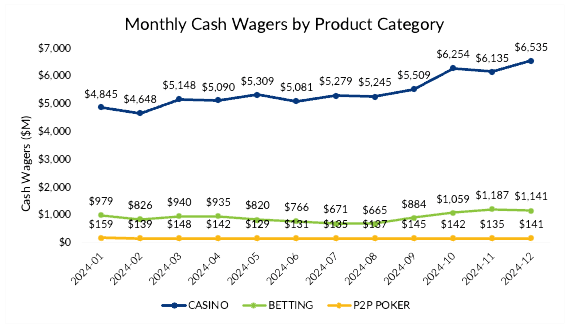
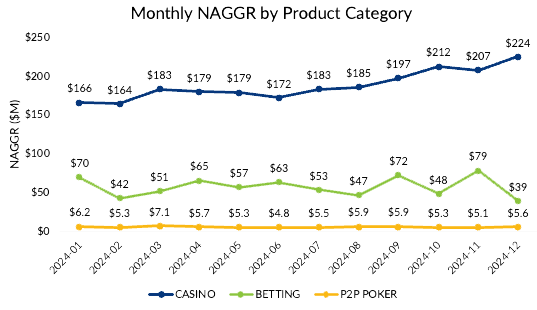
Important to iGO is not just the size of the market but the diversity therein. iGO’s operators are a healthy mix of foreign and domestically owned sites, large-, mid- and small-sized operators, and existing Ontario land-based operators. Each operator brings different games, strategies, and product offerings to Ontario’s market, meaning competition, choice, and options for players. Not only are there over 80 sites to choose from, but over 5,000 regulated games and a large diversity of sports betting markets. Casino games prove to be the most popular by both wagers and GGR, followed by betting markets (traditionally sports betting), and peer-to-peer poker play. Ontario is one of the largest peer-to-peer poker markets in North America and overall ranks in the top 5 markets in the world, by GGR, according to Vixio Regulatory Intelligence.
iGO currently has 51 operators but has also continued to work with prospective operators who have expressed an interest in joining the Ontario market. This interest is in part due to the large Ontario population and the mature market behaviour operators have already seen in the province. However, it can also be attributed to the province’s competitive revenue share rate, the legalization of icasino products in addition to sports betting, the legalization of single-event sports wagering, the lack of land-based ties that are seen in other jurisdictions, and an open competitive process that does not feature an arbitrary cap on the amount of operators in the market.
When these market design factors are combined with an onboarding process that involves personalized account management support, operators are not just invited to join the Ontario market but are welcomed with supportive processes. As the Ontario market matures and stabilizes, iGO can shift its focus to value-add activities such as providing valuable market insights to operators and players, reducing administrative inefficiencies to create a more seamless operator experience, and ensuring Ontario is an innovative market leading the world in all aspects of gaming from new product launches to responsible gambling efforts.
Telling Ontario’s Story
Though many companies have joined the market already, competition around the world is ever growing. As more jurisdictions legalize online sports betting and icasino play, the competition for investment dollars, office locations, and product launches grows. To ensure Ontario experiences the maximum benefit from its decision to regulate igaming, iGO continues to encourage operators to launch, invest, and grow right here in Ontario.
To do this, iGO must tell Ontario’s positive story to the world both by releasing regular market updates and by making investments in a robust data strategy and underlying technologies that will allow for more detailed and comprehensive market insights in the future. This data strategy will take advantage of iGO’s unique position as a central data hub to provide valuable information to the industry regarding player behaviour and trends. These initiatives will help operators refine products to meet consumer needs, create a better playing experience and help to maximize capture of potential revenue that could otherwise be diverted to the illegal market. As a result of these efforts, iGO recently received the Regulatory Initiative of the Year award from Vixio.
iGO has also begun a series of economic development initiatives that includes a commitment to releasing quarterly market updates about the size and strength of Ontario’s igaming market and regular appearances at conferences and panels where operators and suppliers would be in attendance. Some of these venues include the Canadian Gaming Summit, G2E Global Gaming Conference, the Commercial Gaming Association of Ontario/Ontario Charitable Gaming Association Joint Conference, SBC Summit North America, and the ICE Gaming Conference. Additionally, iGO regularly attends and contributes to responsible gambling conferences such as the Responsible Gambling Council (RGC)’s Discovery conference and the New Horizons in Safer Gambling Conference, and anti-money laundering conferences including the Association of Certified Anti-Money Laundering Specialists (ACAMS) Canada conference and the Toronto Compliance and AML Conference.
iGO’s public work also included the release of a key report titled Economic Contribution of Ontario’s Regulated iGaming Market and a follow-up report one year later to update the statistics in the original report. Those reports showed the scale of investment and spend by iGO operators in the province is both substantial and growing, supporting nearly 15,000 jobs, more than $2.7 billion in Gross Domestic Product (GDP) contributions, and a combined $1.24 billion in revenue to federal, provincial, and municipal governments.2 The second year numbers represent a substantial increase from year one, for example jobs supported was up nearly 25% and the GDP figure surpassed the initial five year benchmark. As iGO’s mandate evolves, economic development will become a key part of future planning to ensure that the maximum benefit of the market is being captured right here in Ontario.
Helping Promote the Legal Market
iGO is not a law enforcement agency or a regulator. Nevertheless, it can play an important role in helping the Ontario Government pursue its overall goal of eliminating the illegal igaming market. First, iGO has and will continue to work with operators to comply with the standards set by the AGCO and iGO’s contractual requirements. The process of helping operators to convert their organization and their players into the legal market is the first and most effective step in combatting the illegal market.
Second, iGO has a role to play in educating stakeholders, including players, on the difference between the legal and illegal market. Awareness efforts such as responsible gambling campaigns, requirements for display of the iGO logo on all advertising and operators’ sites and helping educate companies such as advertising agencies or payment processors of the benefit of working solely with legal operators, all work in concert to reduce the appeal of illegal market operators. iGO is committed to working with its government partners, including the AGCO, to further weaken the illegal market and make it more difficult for them to operate within Ontario’s borders.
2Economic Contributions of Ontario’s Regulated iGaming Market (Deloitte, June 14, 2023) https://igamingontario.ca/en/deloitte-economic-contribution-ontarios-re…
BREAKING DOWN BARRIERS
Improving the Market
iGO continues to work closely with its operators to ensure compliance with the operating agreement, as well as relevant applicable law. This includes receiving performance security deposits, enforcing operator insurance requirements, collecting and controlling gaming data, collecting gross gaming revenue from operators, and complying with FINTRAC’s anti-money laundering reporting requirements.
To ensure iGO is as efficient and productive as possible, iGO account managers continue to have regular meetings with operators to troubleshoot issues and develop solutions to any emerging obstacles to growth. iGO participates in regular communication with operators through its external consultation platform iGOConnect.ca, ad-hoc conversations and meetings with operators, and through semi-annual Operator forums and project-specific working groups. These interactions enable the discussion of emerging issues in the gaming space and the collection of feedback on proposed initiatives and policy changes. These channels of communication assist iGO in refining its policies, the operating agreement, and contemplate future unforeseen issues as well as assist iGO in determining which of its processes can be automated, managed by outside vendors, or run more smoothly to reduce friction and cost.
Pursuing Workable Solutions
To continue to improve and grow the market, iGO is committed to working with government partners to solve remaining regulatory and legislative barriers that may exist. This includes future work with the Ontario Lottery and Gaming Corporation to support omni-channel player offerings for Ontario’s existing land-based operators that may seek to open igaming sites and building on the work already done with charitable gaming venues and bingo halls, for example. This work also includes model expansion initiatives such as iGO’s role in enabling pari-mutuel horse racing wagers under CPMA regulation and supervision apart from iGO’s conduct and manage model, through its operator’s sites and the onboarding of Canada’s first legal betting exchange. As mentioned in iGO’s 2024-2025 Letter of Direction, iGO also stands ready “to support the government’s objectives and policy development activities to drive increased growth and enhanced consumer choice in the igaming framework.” This work includes future initiatives, such as the existing reference question with the Court of Appeal, to solve liquidity challenges and helping expand the model to other provinces, if requested. These expansions are subject to government policy and regulatory change but, if pursued, iGO stands ready and willing to help.
These new ventures will help ensure Ontario’s gaming market is a world leader and iGO is committed to working with its partners to develop these opportunities.
Gathering Direct Feedback
In addition to the operator consultation processes, iGO has also launched a direct player feedback process through player focus groups in the 2023-24 fiscal year and by continuously monitoring player feedback through call centre complaints made to the joint iGO/AGCO customer service centre. iGO plans to expand this program in the 2024-25 fiscal year and beyond.
Lastly, given iGO’s unique position as a central repository of igaming-related data iGO can derive and share valuable Ontario market insights and observations. iGO is completing both a digital and data strategy with external vendors to ensure proper data validity and formatting to allow for better market insights in the future.
EMPOWERING CUSTOMERS
Anti-Money Laundering Requirements
As the agency mandated to conduct and manage igaming in Ontario, iGO must report to FINTRAC certain transactions such as large withdrawals or suspicious transactions. Given the size of the market, iGO processed over 78,500 reports to FINTRAC in its first two and a half years of operations. Currently, these reports are processed manually by operator and iGO staff, taking up significant time and resources. As a result, iGO has secured an external vendor to build a system that will automate the required anti-money laundering reporting process and reduce the need for manual staff input all while improving efficiency.
Responsible Gambling Tools
Core to iGO’s mandate is the promotion of responsible gambling as a key function of the market. iGO operators must obtain RG Check accreditation from the Responsible Gambling Council within two years of go-live and all operators have completed or are on track to meet this requirement.
iGO has released its policy to operators that requires them to dedicate a portion of their gross gaming revenue to responsible gambling advertising. Operators are currently running these advertisements live in market and must submit compliance reports to iGO which will be reviewed to ensure effectiveness of the campaigns. iGO is committed to ensuring it is driving maximum results and awareness of responsible gambling tools that are available to players.
Additionally, the creation of a centralized self-exclusion registry that enables players to self-exclude from all Ontario regulated igaming websites at once, including OLG.ca, remains a top priority. iGO has secured an external vendor for this project and begun work to build this system. All told, these measures empower customers to protect themselves from the risks of gambling and play with confidence.
BUILDING IGO UP
Ensuring the Right Employee Complement
iGO’s employees play a critical role in delivering on the agency’s mandate. As the organization moves forward, it has been transitioning from a start-up mode focused on onboarding operators to a more mature state of operations, iGO is continually reviewing its structure to ensure the optimal staffing design and skill set.
Going Digital First
iGO’s operators provide an online service, as iGO’s agents, to players in Ontario. As a result, almost all their interactions with players – and by extension iGO’s interaction with players – are online. iGO needs to be a digital first organization to lead the world’s best gaming market. Processing the tens of millions of pieces of gaming data, billions of dollars of GGR payments, and thousands of anti-money laundering reports per year requires significant digital infrastructure.
iGO recently completed a series of procurements for infrastructure technology systems that have allowed iGO resources to be centrally located on its own tenant. Additionally, iGO is working with external vendors to build an automated anti-money laundering solution to reduce delays and potential manual errors, an automated centralized self-exclusion system, and a digital and data strategy to better automate data reporting and allow for more actionable insights. Each of these systems requires significant one-time financial investments and, the appropriate staffing resources to oversee their operations and utilize the data collected. This work will be performed throughout the rest of the 2024-2025 and into the rest of the business planning cycle.
Building Internal Processes
When iGO was first established, many internal processes and policies had to be created for the first time. The Board of Directors was previously seized with approving critical policies and assisting in building the foundation of the organization. Now, given many of the needed policies have been established, the Board can transition to focus on longer-term strategic direction and performing regular evaluations of the organization against its stated objectives. This work has already begun with the Board completing risk identification and mitigation work as well as long-term strategic planning work, both of which have informed the organization’s business planning for 2025-26 and beyond. The Board has also recently established a 360-evaluation process, with the first evaluation taking place in 2023-24. The evaluation involves both a self-evaluation completed by board members and a senior management evaluation of the board. This evaluation process will contribute to ensuring good governance practices through regular assessment of the Board’s performance, identification of skills gaps, and support future needs.
Section 6: Staffing, Human Resources and Compensation Strategy
As a new agency, iGO’s initial focus was on establishing the foundational capabilities to support the growth and rapid evolution of the industry. Staff have worked tirelessly to ensure iGO meets its legislated mandate. iGO is committed to supporting its staff and to promote a culture of diversity, equity and inclusion, ensure strong succession planning and support a healthy life-work balance.
Securing Office Space
As the COVID-19 pandemic ended, iGO had to adapt to the new realities of a hybrid workplace. During iGO’s first year the agency was almost fully remote. Now, employees work in-office a minimum of three days per week, in compliance with government directives. To enable an in-office three days per week model, iGO secured temporary office space through a sub-lease which expires in the 2025-26 year. iGO will be actively evaluating cost effective and modern lease options while fully complying with the Ontario Realty Directive and Interim Measures as it seeks a more permanent location, which could include an extension of the existing lease.
iGO’s Compensation Strategy
iGO’s compensation strategy, including employee benefits, is in line with the Broader Public Sector expectations and directives. Please note this package of pension and benefits will be transferred to a separate enrollment outside of the AGCO once the subsidiary relationship with the AGCO is severed, which is anticipated early in the business planning cycle. iGO provides a comprehensive benefits package including the following:
- 100% Employer-Paid premiums for Basic Life, Basic AD&D, Health, Dental and Long-term Disability
- Defined Benefits Pension Plan administered by the Ontario Pension Board (for non-bargaining employees) and OP Trust (for bargaining staff)
- Short Term Income Protection for permanent staff to a maximum of six months (130 working days) in the calendar year
Bargaining Agent
The bargaining unit for iGO is OPSEU Local 565.
iGO Headcount
iGO’s current staffing allocation totals 86 FTE staff members, not including the Board of Directors, though some positions are still being recruited. Of the 86 FTEs, 1 is currently an executive position.
iGO has utilized outside expertise and services where necessary and has also used both contract and temporary staff to ensure the right size and fit for iGO.
iGO’s current organizational structure is captured below. The organization is separated into seven business units, each run by management-level employees. As noted above, iGO is currently in the midst of several large-scale projects including, but not limited to, a centralized self-exclusion system, a digital and data strategy, and an automated anti-money laundering reporting system. Though external vendors have been procured for these projects, they each require dedicated resources, project management, and specific expertise to both build and operate once live. As a result, iGO is currently hiring additional employees and anticipates it will need to continue to grow. Currently, iGO is planning to gradually increase its number of employees to 120 FTEs over the business planning cycle, of which at least three will be executive positions.
Though this represents a large growth for the organization, iGO is committed to living within its means and ensuring that expenses do not outpace revenues. As such, iGO has instituted a KPI to ensure a healthy ratio of net income per FTE. In 2022-23, that ratio was $2.7 million in net income per FTE. In 2023-24, that ratio rose to $3.7 million in net income per FTE. In 2024-25, even with the slight increase in staff, that ratio is projected to be $4.5 million in net income per FTE, well above iGO’s original KPI target of $2 million in net income per FTE. As a result of this performance, iGO has moved this target to $3 million in net income per FTE for the remainder of the business planning cycle.
Table 2: iGO's Current Organizational Structure:
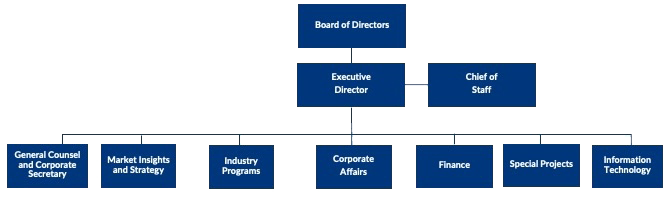
iGO's Organizational Structure (Accessible view)
- Board of Directors
- Executive Director
- General Counsel and Corporate Secretary
- Market Insights and Strategy
- Industry Programs
- Corporate Affairs
- Finance
- Special Projects
- Information Technology
- Chief of Staff
- Executive Director
Section 7: Information Technology (IT) / Electronic Service Delivery (ESD) Plan
Investment in iGO’s IT infrastructure remains critical to meeting our strategic goal of leading the world’s best gaming market, which includes improving how iGO collects, analyzes, and reports data about its gaming market. Significant progress was achieved in prior fiscal years to realize iGO’s immediate goals of achieving technological self-sufficiency, building a strong IT team and procuring the necessary Managed Detection and Response (MDR) cybersecurity services. The focus for the next three years continues to be automation and continuous efficiencies through technology while further maturing our cybersecurity capabilities.
Recognizing the significant importance of operator gaming data that is subject to iGO’s control, iGO will be concentrating on the development of a data governance framework with a focus on data quality and accuracy to reduce time-consuming processing, cleanup, and analysts’ work effort. This will be part of an overall data strategy that is right sized for iGO to reduce complexity and promote adaptability while introducing modern and scalable technologies for data ingest, storage, and analytics while ensuring compliance with all relevant privacy legislation. An external vendor has been procured to assist with the development and execution of this strategy.
Anti-money laundering compliance remains a priority for iGO and is considered integral in the overall data governance and strategy initiatives. iGO has procured an external vendor to help improve operator data ingestion processes and automate analytics to better identify suspicious transactions and high-risk operators and players. In addition, this work will streamline FINTRAC reporting to reduce manual work being performed by operators and employees.
iGO, with input from operators and the OLG, has procured a vendor to support the build out and implementation of a viable and robust province-wide self-exclusion registry for igaming. This is a shared priority for both operators and iGO and will provide another tool to protect vulnerable players.
Further work to continue strengthening iGO’s cybersecurity processes is underway, including the implementation of programs such as security awareness training, phishing email simulation, privileged identity management (PIM), and conducting internal security audits. These and other important measures are being undertaken in accordance with critical security controls developed by the Center for Internet Security (CIS) and with a goal of achieving Implementation Group maturity level 2 (IG2).
While iGO recognizes the potential of Generative AI (GenAI), we currently do not have specific use cases for it beyond assisting our staff with their internal daily tasks through Microsoft Copilot. Microsoft Copilot is the only approved GenAI tool to be used by iGO staff, and its application is focused on enhancing productivity by providing support in such activities as drafting documents, summarizing large content, performing research, or facilitating communication. iGO does not plan on implementing any GenAI agents based on large language models (LLM) that would interact with external stakeholder through public facing sites or applications.
However, iGO does have a primary focus on leveraging rule-based AI or machine learning (ML) for more critical functions in the next three years. These functions will facilitate iGO’s adoption of automation within our data analytics practices, where we analyze large internal datasets to extract actionable insights. As well, we will leverage rule-based AI/ML for regulatory transaction monitoring, to help automate AML reporting to FINTRAC. Another area where rule-based AI/ML will be leveraged is in matching algorithms that will allow Ontarians to self-exclude from all gaming operators within the province. These rule-based AI/ML applications are essential for maintaining the integrity, security, and efficiency of our operations. Note that, these AI/ML algorithms would leverage iGO’s internal data sets and not a LLM that could potentially be susceptible to such risks as hallucinations or unintentional bias.
Section 8: Initiatives Involving Third Parties
iGO’s core operations rely on external third-party agents that provide services on behalf of and as agent of iGO, to individuals located in Ontario. Therefore, most initiatives undertaken by iGO involve third parties in some capacity. This means external engagements with third parties are pivotal to iGO’s ongoing success and igaming market growth.
Building on that work, iGO has created a voice of the player process that will allow feedback from players in Ontario directly to the agency for the first time. iGO continues to monitor trends arising from its customer call centre to ensure the voice of the player, positive or negative, is properly understood and actions are taken accordingly.
iGO will continue to work with external partners who either work in conjunction with or alongside iGO. This includes the AGCO as the regulator of iGO, the OLG as another provincial agency responsible for conduct and management, the Ontario Provincial Police and FINTRAC as it relates to anti-money laundering work, the Responsible Gambling Council as it relates to responsible gaming measures, the Government of Ontario and its Ministries, Indigenous representatives including the Ontario First Nations Limited Partnership (OFNLP), and third-party associations representing the industry and its economic development opportunities such as the Canadian Gaming Association or Ontario-based post-secondary institutions.
iGO is pleased to receive direction from the Ministry of the Attorney General on a series of third-party initiatives contained within its 2025-2026 Letter of Direction. These directions include:
- Working on initiatives that foster market competitiveness, operational efficiencies, and revenue generation, including working with the AGCO to ensure regulatory compliance as iGO becomes a stand-alone agency. iGO regularly meets with members of the AGCO to ensure harmony in areas such as anti-money laundering, responsible gambling, player fairness, market expansion, and in efforts to weaken the illegal market.
- Developing iGO as a leader in market data and consumer insights, for which iGO is actively developing and implementing both a digital and a data strategy to allow for the proper ingest and analysis of hundreds of millions of pieces of gaming related data from operators.
- Working with OLG on areas of common interest including responsible gambling for which iGO is proceeding on the development of a centralized self-exclusion registry and anti-money laundering measures.
- Supporting the government’s policy development activities to drive increased growth and enhanced consumer choice, including a potential role for iGO in expanding Ontario’s regulated igaming market model to other provinces. iGO continues to support the government in its efforts to resolve international liquidity issues and iGO continues to offer advice, documentation, and support to other provinces interested in launching a regulated private igaming market.
- Continuing to work with government to support relationships with First Nation partners, including the Ontario First Nations (2008) Limited Partnership, to improve information sharing and continued good faith discussions on revenue sharing opportunities balanced with the need to ensure the continued financial viability of iGO and the pursuit of the government’s overall objectives for the igaming market in Ontario.
- Continuing to work with government and agency partners on opportunities for red tape reduction, including data sharing, improving the customer experience, and increasing revenue all while complying with legal and regulatory requirements and government directives. iGO continues to work with external partners like the OLG, AGCO, Supply Ontario, and federal agencies such as the CPMA and FINTRAC to find ways to reduce barriers, grow revenues, keep expenses low, and comply with legal and regulatory requirements.
Section 9: Communication Plan
To deliver on its mandate, iGO must clearly and consistently communicate to both internal and external stakeholders. An effective communications strategy is critical in ensuring players can play with confidence, knowing that they are playing on a site that is safe. Communication to Ontarians about the new igaming market and its benefits is an important priority.
Website
The iGO website is regularly updated with relevant content, including a live list of regulated operators to inform consumers and quarterly market updates regarding iGO’s performance, which iGO plans to make monthly soon. The site has distinct sections dedicated to players and operators, as well as an ‘About iGO’ section for corporate reporting and public disclosures.
The player section includes a list of iGO’s approved igaming websites as well as information about responsible gambling tools and the benefits of the legal market. There is also an escalation path for dispute resolution should any players have concerns about their dealings with an operator.
On the operator side of the website there is information explaining how to join Ontario’s legal market, the benefits of doing so, and links to iGOConnect.ca, iGO’s engagement platform for operators and prospective operators.
Social Media
iGO is using social media (X, formerly known as Twitter, LinkedIn, and Instagram) to engage proactively with Ontarians about operators that have joined the legal market, responsible gambling tools, and other important messages such as iGO’s quarterly market performance reports. In addition to proactively informing the public of igaming related developments via these channels, iGO also uses these accounts to respond to player issues, as well as for gathering information and viewpoints from players, allowing iGO to further include the voice of the player as an input into its decision-making process.
Media Relations
iGO regularly communicates with members of the media to provide information that helps tell iGO’s story, including the benefits of the legal market, in the most efficient way possible. This includes proactive press releases and responding to media inquiries on an as needed basis.
Section 10: Diversity, Inclusion and Environmental, Social and Governance (ESG) Planning
Diversity and Inclusion
iGO is committed to being a diverse and inclusive workplace for all. iGO, in all its decision making, prioritizes the needs of its current and future potential workforce, including women, racialized communities, Indigenous peoples, the LGBTQ2S+ community and persons with disabilities. As iGO grows and creates additional internal policies, this lens will be applied, ensuring that diversity and inclusion planning is a core tenet from the outset, not a future edit or afterthought.
ESG Approach
iGO has prioritized an ESG approach in its work from its inception. Given iGO’s operators provide a digital service, embedding a digital first philosophy that reduces environmental waste is a core tenet of iGO’s business. On social matters, iGO has created an internal Corporate Social Responsibility committee to spearhead social initiatives such as United Way fundraising campaigns and the creation of volunteer days for staff to dedicate themselves to important community causes. On governance, iGO’s board has created Conflict of Interest policies, committed to the transparent and open publication of data on a regular basis, and embedded practices that meet the highest levels of integrity and accountability to the Government and the people of Ontario.
Section 11: Multi-Year Accessibility Plan
iGO’s accessibility plan and policy is available on iGO’s website. These policies are in accordance with the Integrated Accessibility Standards Regulation (IASR) under the Accessibility for Ontarians with Disabilities Act, 2005 (AODA). iGO will strive to remove barriers for people with disabilities and to create a workplace that is accessible for all. iGO is committed to a future where all external documents created by the organization, including this one, are presented in an accessible format, thereby meeting the Web Content Accessibility Guidelines.
As part of iGO’s shared services agreement with the AGCO, every iGO employee since day one has been trained on the requirements of Ontario’s accessibility laws, including the AODA, IASR and the Ontario Human Rights Code as it pertains to persons with disabilities. This accessibility training has been built into the employee orientation process to ensure that iGO employees and the Board of Directors, have a thorough understanding of accessibility challenges and responses.
Section 12: Three-year Financial Plan
Table 3: iGO's Three-Year Financial Plan
(In Millions $)
FY24-25 Forecast
FY25-26 Budget
FY26-27 Plan
FY27-28 Plan
REVENUE
Adjusted GGR (AGGR)
2,920.1
3,687.8
3,820.8
4,023.3
Less: Operator Revenue Share
2,336.1
2,950.3
3,056.6
3,218.6
iGO Share of AGGR
584.0
737.5
764.2
804.7
Other Income
9.5
5.0
4.4
3.0
Total iGO Net Revenue
593.5
742.5
768.6
807.7
EXPENSES
Total Salaries & Benefits
13.8
17.3
19.0
20.3
Total Other Direct Operating Expenses
6.5
31.8
19.7
13.8
Total Expenses before Stakeholder Payments
20.3
49.1
38.7
34.1
NET INCOME BEFORE STAKEHOLDER PAYMENTS
573.2
693.4
729.9
773.5
HST Expense
307.3
391.9
402.4
422.0
Gaming Revenue Share Financial Agreement Expense
41.4
54.6
62.7
72.2
NET INCOME AFTER STAKEHOLDER PAYMENTS
224.5
246.9
264.8
279.4
iGO's 2024-25 fiscal year is once again expected to surpass original estimates, with full year adjusted GGR estimated to end the year at $2.9 billion, approximately $426 million higher than originally budgeted. Several factors have combined to create continued faster-than-anticipated growth. First, casino play continues to grow both in real dollars and as a proportion of the market. This is combined with stronger than anticipated performance in both the sports betting and peer-to-peer poker markets. Second, operators have begun pursuing profitability more regularly, meaning fewer promotional losses and more incentives toward higher margin products, which in turn helps increase overall GGR. Lastly, recessionary economic events have either not occurred or been weaker than anticipated, leading to a more resilient market. Lastly, recessionary economic events have not had the anticipated impact on discretionary spending of Ontario’s igaming players, leading to a more resilient market.
These numbers are the sign of a strong, stable, and competitive igaming market that features more operators than any other jurisdiction, the largest per-capita peer-to-peer poker market in North America, and a top overall igaming market both by revenue and by handle.
Between launch in fiscal 2022 and the 2024-25 fiscal year, iGO operators have generated $182 billion in wagers and $6.4 billion in GGR. By the end of the business planning cycle, GGR is projected to be $18 billion since market launch.
Specifically, fiscal 2025-26 continues this growth trajectory, with potential economic pressures being offset by continued market acceleration. Total fiscal 2025-26 Adjusted Gross Gaming Revenue (AGGR) is expected to reach $3.7 billion and Net Income after Stakeholder payments projected to reach $247 million, a 10% year-over-year increase. However, there is a large amount of uncertainty surrounding economic growth in general with ongoing trade disputes and the impact of potential tariff action. To ensure a reasonable and reliable growth target, iGO is committing to an annual growth rate target of 10% year-over-year from 2024-25 to 2025-26. This growth target will be revised annually during the business planning period to ensure accuracy and maximum value for the Ontario government.
Over the course of the business planning period, iGO is projecting to increase its net income after stakeholder payments to just under $280 million in fiscal year 2027-28, which represents an average annual increase of about 8%. The HST payment is also projected to reach 422 million, a portion of which is returned to the province.
Revenues are projected to increase throughout the business plan, growing to just over $4.0 billion in the 2027-28 fiscal year. This reflects a 11.3% compound average growth from 2024-25 to 2027-28. This level of growth is aligned with iGO’s KPI under the Growing the Economy pillar, which projects 5% average annual growth in this metric over the planning period.
Throughout the next three years, iGO is planning to carry out various initiatives aligned to each of its core pillars (Breaking Down Barriers, Growing the Economy, Empowering Customers and Building iGO Up). Most notably are the design and launch of a centralized self-exclusion system, the creation and execution of both a digital and data strategy, and the launch of automated anti-money laundering reporting and monitoring. These activities will enable the achievement of iGO’s key performance indicators and deliver greater reliability and performance, all while reducing costs for operators, improving the experience for players, and promoting responsible gambling. Accordingly, there is an increase in operating costs during the design and implementation phases of these initiatives. As a result, expenses are projected to increase from about $20 million in fiscal 2024-25 to approximately $49 million in fiscal 2025-26, levelling off to $39 million and $34 million in the subsequent years. However, each of these investments will create a safer, more sustainable market as players experiencing harm from gambling can be properly protected by self-excluding; operators, players, and responsible gambling researchers can all gain a better understanding of the Ontario market with actionable data that can be used to create a healthier long-term market; and operators can reduce costs through automated anti-money laundering reporting that reduces the threat of manual errors and monetary fines to iGO while helping to identify money laundering activities.
That said, the two most material costs to iGO, reflected in the table above, remain its GST/HST payments and payments to Ontario First Nations Limited Partnership (OFNLP). GST/HST costs increase in line with the increased revenues and payments to operators, given that this tax obligation is calculated as a percentage of payments to operators, thus directly variable with operator payments. As operator payments increase, so do iGO’s GST/HST costs. However, the net tax generated for the federal and provincial government correspondingly increases, all these net new taxation dollars are a result of the new igaming model in Ontario and benefit every province in the country, including Ontario.
Payments to the OFNLP also are planned to increase by 32% in fiscal 2025-26 driven by substantially higher prior year’s unadjusted GGR. It should be noted that iGO, the Ministry of Tourism, Culture and Gaming, the Ministry of Indigenous Affairs and First Nations Economic Reconciliation , and OFNLP are currently in negotiations with respect to the application of the Gaming Revenue Sharing and Financial Agreement to the lottery schemes conducted and managed by iGO and as such the numbers in out years of the business plan may change.
Section 13: Performance Measures and Targets
iGO has identified six key performance indicators (KPIs) to measure the performance of the organization. Given the newness of the organization, some of these key performance indicators still require baselines to be set and benchmarking to be conducted to evaluate progress and conduct future measurement exercises. Similarly, iGO is routinely evaluating the effectiveness of these KPIs to ensure the right mix of performance indicators as the organization matures. Below is a summary of the 6 KPIs and the organization’s performance to date in achieving these outcomes.
These KPIs were chosen to ensure an organization-wide view of effectiveness across the seven business units. In addition, they reflect the priorities of iGO management, the iGO Board of Directors and the Government of Ontario as seen in the organization’s mandate. Lastly, in addition to these KPIs, iGO has established goals within each pillar that contribute to the overall progress in achieving each of these KPIs. These more detailed goals will be tracked internally for the iGO Board of Directors to review to ensure success and achievement of the organization’s KPIs.
Of note, iGO is either on track to pass or has passed 4 of its 6 KPIs with 1 KPI below target and the other in progress.
This year, the Ministry of the Attorney General, in its annual letter of direction, outlined a requirement for iGO to align its goals, objectives and strategic direction with three core actions, being: innovative, sustainable, and accountable.
Innovative:
- iGO’s KPI on channelization forces the organization to be nimble, respond to player demands, pursue new market expansion opportunities – such as international liquidity – and create an attractive market that entices operators to join.
- Similarly, to grow player awareness of responsible gambling tools, iGO must consider innovative approaches using data-driven decision-making to improve player awareness of these digital first tools.
Sustainable:
- iGO’s KPIs on increased revenue growth and on keeping a healthy net income to FTE ratio ensure that the organization continue to grow in a responsible way that prioritizes revenue for government priorities, ensures the organization does not grow too large too fast, and continues to be an efficient and sustainable use of government resources.
Accountable:
- iGO’s KPIs on employee and operator approval are designed to keep the organization accountable to those who help it thrive. When combined with voice of the player efforts elsewhere in the organization, iGO’s KPIs ensure that it is listening to those it impacts and doing right by its external and internal stakeholders.
The KPIs and iGO’s performance are as follows:
| # | Outcomes for End Users or Beneficiaries | Performance Indicators to Measure Outcomes | Baseline Value and Date | Target Value and Date | Trend Values and Dates | Frequency (e.g., quarterly, annually) and Source of Data Collection |
|---|---|---|---|---|---|---|
| 1 | More players in the legal market contributing to government revenue and experiencing safer play | This KPI uses channelization rate of players to determine the appeal of the regulated market over the unregulated market. Players are anonymously surveyed and self-report what gaming sites they use during a certain period. iGO then reports the percentage of players that indicated using a regulated site as its channelization rate. This method is also used and shared with the AGCO. | iGO set a target of 90% by the 2026-27 fiscal year, which would be among a world leader in channelization rate. To allow for reasonable accommodation to meet that goal over time, iGO set a staggered 5% increase year-over-year from 2022-23 to 2026-27 to meet that goal, meaning the original baseline target was 70% in 2022-23. |
This KPI was originally targeted to grow 5% a year to an ultimate goal of 90% by year 5 (2026-27). The breakdown is as follows for target rates:
Once the goal is reached, iGO will need to set a new target, likely to maintain that channelization rate to ensure a continued appeal of the regulated market over the unregulated one. |
|
This data is collected annually and is currently collected via an IPSOS player study conducted during Q4 of each fiscal year. iGO is developing a more robust definition of channelization that will include statistics related to volume of play on each site to determine the value of channelization instead of the current definition which solely measures which site a player uses to determine channelization. |
| 2 | Achieve average growth in total revenue of 5% a year between 2023-24 and 2027-28 to ensure maximum value for the Ontario government | This KPI is measured with net income before stakeholder expenses, meaning it is a measurement of how much revenue iGO makes prior to HST or OFNLP payments but after iGO deducts its own expenses and operator payment costs | The total revenue number of $430.3 million in 2023-24 will be used as the baseline. This year was chosen, instead of 2022-23, because it reflects the first year with a more accurate complement of operators and thus a better projection of future revenue |
This KPI features a 5% year-over-year target which shows as follows:
|
iGO is currently projecting:
|
This measure is reported annually once the fiscal year is closed. The source of data is iGO’s audited financial statements. This KPI will be revisited annually and likely adjusted upward in the near future in line with the now stated net income growth target of 10% year-over-year in this current business plan for the 2024-25 to 2025-26 period. It should be noted that iGO is anticipating slower revenue growth due to market maturity and larger economic factors. |
| 3 | Maintain Operator approval target of 80% to ensure the long-term viability of operators in the Ontario market | This KPI is measured by surveying operators on a wide-ranging set of questions to reflect their treatment by iGO and the Ontario market. These numbers are weighted and scored into a top line figure, presented as an overall approval percentage. | The baseline for this KPI is the original operator approval score of 80% conducted in the 2023-24 fiscal year. |
Over the course of the business plan, iGO is aiming to maintain the operator approval rating at 80%. That means the targets are as follows:
|
Currently only the year one, 2023-24, approval rating is known. That figure is 80%. This survey is conducted after the fiscal year end to capture a true performance metric for the year as a whole, so it is one year in arrears. | This KPI is measured annually. The source of the data is the iGO operator survey. The survey is conducted by an independent third party and operator results are kept anonymous to ensure confidentiality and accurate results. The 2024-25 statistics will be known early in the next fiscal year. |
| 4 | Increase iGO player awareness of responsible gambling tools by 5 percent annually to ensure players can adequately protect themselves from undue gambling harm | iGO is measuring player awareness of certain responsible gambling tools, such as deposit and time limits, to ensure players know how to protect themselves from undue harm | The 2023-24 baseline awareness level of responsible gambling tools was 65.4% among iGO players surveyed. |
iGO seeks to increase this target by 5 percent annually over the business planning cycle, meaning:
|
Year 1 (2023-24): 65.4%. The study is conducted at the end of the fiscal year to capture the most accurate awareness levels, meaning it lags one year in arrears and the 2024-25 numbers will be available upon year end. | This KPI is measured annually at fiscal year end and is conducted through an independent third-party survey of a sample of iGO players. Players are surveyed on awareness of a variety of responsible gambling tools, including time and deposit limits, and those results are used to build an aggregated overall awareness score. |
| 5 | Achieve a net income to FTE ratio of $3 million per FTE and sustain to ensure that the Ontario government is getting a maximum return on its investments in the agency. | iGO develops this ratio by measuring its adjusted net income before OFNLP expenses, against its total FTE complement to give an overall sense of the efficiency of the agency. | In iGO’s first full year, 2022-23, the year end figure was $2.7 million of net income per FTE. That number increased to $3.7 million of net income per FTE in 2023-24. |
The original target was to maintain a ratio of $2 million of net income per FTE. However, with significant overperformance in the first two years, iGO increased that target value to $3 million in net income per FTE. Meaning the future year targets are:
|
This KPI resets annually and given projected increases in FTEs in order to implement new anti-money laundering and self-exclusion systems, iGO feels maintaining this KPI will ensure continued operational excellence. iGO will review this target annually in case the KPI needs to be adjust upwards in the future. |
This KPI is measured annually at fiscal year end. The data source is a combination of the organizations audited fiscal statements and year end payroll statistics to determine the ratio. iGO tracks this data quarterly to ensure the target is met, but reports this publicly on an annualized basis. |
| 6 | Maintain employee satisfaction target of 80%. This ensures iGO is a great place to work and can get the most out of staff to meet its operational goals. | iGO surveys all staff anonymously on a variety of employee satisfaction figures and uses these numbers to build an aggregated view of employee satisfaction. | iGO’s inaugural staff survey returned a score of 82% approval. Accordingly, the baseline target was set at 80% given that, as the market develops and grows, demands on staff also grow. Similarly, a jurisdictional scan of similar agencies and civil service employees indicated 80% would be a strong and potentially difficult target to maintain. |
Given the KPI is to maintain the approval rating of 80% the minimum target for iGO is 80% in each fiscal year over the course of the business planning period:
|
|
This KPI is measured annually. The two scores are averaged out to create an overall annual score. Therefore, iGO has an interim score of 75% for the 2024-25 year, which is currently below the target. The source of the data is an iGO led, anonymized employee survey. |
Of note, iGO previously reported on a KPI to reduce touch time on data and onboarding processes by 20%. This KPI is no longer being reported as the iGO team achieved this goal in the 2023-24 fiscal year by reducing onboarding processes from ten weeks to 8 weeks and reduced touch time for data validation by 25% from 20 days to 15 days.
Similarly, iGO also plans to review and refresh its KPI’s for the 2026-2029 business plan. Specifically, the launch of both a centralized self-exclusion system and automated anti-money laundering reporting will give iGO greater reporting abilities in these areas and allow for unique player identification numbers to more accurately track the number of unique players on iGO sites, rather than the number of accounts. As a result, iGO plans to revise its KPIs in conjunction with the launch of these systems during the business planning period.